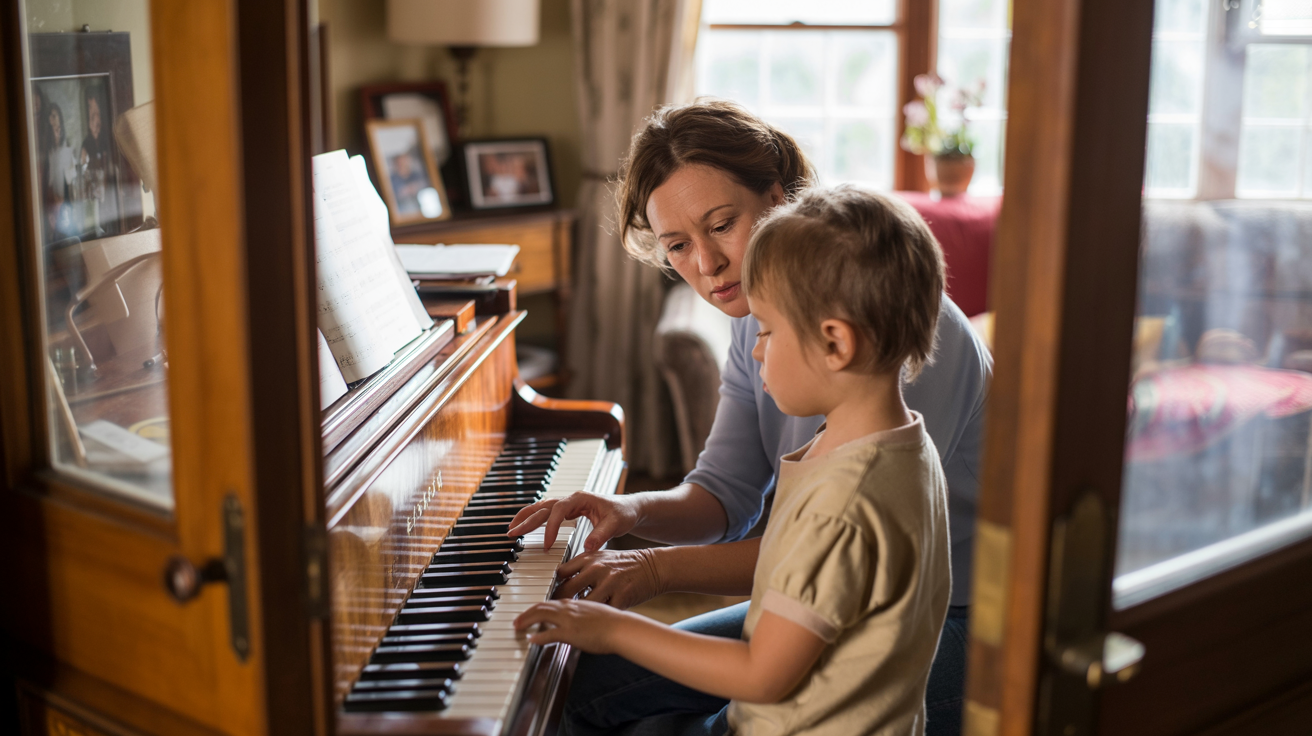
You drop off snacks, say goodbye, and hear the familiar sound of scales drifting from the living room. But what's actually going on during that 30 or 45-minute session?
Most parents have no idea about the preparation, quick thinking, and personalized adjustments happening behind the scenes. At Playtime Music Academy of Greater Baltimore, we've been helping families throughout the Baltimore Metro area since 1993, and here's what we've learned: there's way more to an in-home piano lesson than just playing notes.
The Hours Before Your Child Sits Down
The lesson officially starts when we arrive at your door, but the real work begins hours earlier.
We're sourcing sheet music that matches your child's interests. If they love movie soundtracks, we're hunting down arrangements at the right difficulty level. If they're struggling with a concept, we're marking up scores with helpful reminders and creating custom exercises.
Pre-lesson prep includes:
- Reviewing practice recordings or notes from last week
- Adjusting lesson plans based on your child's mood or recent challenges
- Selecting new pieces that build on current skills without overwhelming
- Coordinating with parents about upcoming recitals or goals
One music educator puts it perfectly: "Teaching piano doesn't end when the lesson does. Behind the scenes, there are many hours spent marking, sourcing music, and liaising with parents."
This kind of attention just isn't possible in group settings. When you work with a piano teacher in Pikesville, MD, you're getting someone who's thinking about your child's progress all week long, not just during lesson time.
What Actually Happens in Those First 10 Minutes
We don't just dive into last week's assignment. The warm-up phase sets the tone for everything that follows.
Typical warm-up activities:
- Finger exercises to build strength and dexterity
- Scale practice for technical foundation
- Hand position checks and posture corrections
- Quick rhythm games or ear training
These aren't filler activities. They're carefully chosen based on what your child needs that day. Maybe their shoulders are tense from school stress. Maybe their fingers are flying through scales, showing they're ready for something harder.
Here's what makes in-home lessons different: we're watching micro-expressions the whole time. A slight frown when approaching a tricky measure tells us to slow down. A spark of confidence means we can push a little further. This real-time adjustment keeps frustration low and progress steady.
The Review Process You Never See
When we revisit last week's assignment, it's not about right or wrong. It's about identifying exactly where technique needs refining.
We're listening for things most people wouldn't catch:
- Is the thumb tucking smoothly during scale passages?
- Are dotted rhythms being counted accurately?
- Is the pedal being lifted at the right moment?
- Are dynamics creating the intended emotion?
In 2025, we're also using apps like Simply Piano for between-lesson reinforcement. Over 10 million learners use these tools, and they provide instant feedback that helps students practice more effectively at home. During lessons, we can see exactly where students struggled during their solo practice time.
According to industry reports, the global piano training market is projected to reach $20.5 billion by 2033, growing at 5.1% annually. Much of this growth comes from in-home formats because of the personalized attention providers like Playtime Music Academy of Greater Baltimore can offer.
Introducing New Concepts Without Overwhelm
This is where teaching becomes part science, part art.
We introduce one new element at a time, whether that's a new time signature, a hand coordination challenge, or an unfamiliar key. We break it down, demonstrate it, then watch your child try it while offering gentle corrections.
The goal isn't perfection in one lesson. As one educator wisely notes: "The slower you go, the faster you'll get there."
How we structure new learning:
- Demonstrate the concept on the piano
- Explain what makes it work using simple language
- Guide your child's first attempts with verbal cues
- Adjust based on their immediate response
- Reinforce with a fun application or simplified version
In group classes, a teacher might miss the exact moment a child's confidence wavers. In your living room, we catch it instantly and adjust our approach.
The Emotional Support Parents Don't Witness
Piano lessons aren't just about technique. They're about building confidence during a vulnerable learning process.
Some days, your child walks in excited. Other days, they're discouraged about a piece they can't seem to master. We adapt every single time.
Research shows that children in one-on-one settings like voice lessons or piano instruction at home can experience up to 20% better retention in cognitive skills compared to group classes. Part of that comes from the emotional safety of learning privately.
When a student makes a mistake, there's no peer judgment. When they nail a difficult passage, the celebration is personal and genuine. This environment builds self-esteem in ways that are hard to measure but impossible to miss over time.
According to the American Psychological Association, music education correlates with reduced stress and improved social skills. We see this firsthand when a shy child gradually opens up or an anxious student learns to work through mistakes without shutting down.
The Technology Boost You Might Not Know About
In 2025, in-home lessons blend traditional teaching with smart technology. Over 35% of new music enrollments are now in-home or online formats, driven by parental preference for convenience and individual attention.
We're using apps for practice tracking, recording progress clips, and providing interactive exercises between visits. AI-assisted tools help students get immediate feedback when practicing alone, making every practice session more productive.
This hybrid approach means your child isn't just learning during lesson time. They're getting reinforcement throughout the week that keeps concepts fresh and builds skills faster.
Why In-Home Lessons Work Better for Many Families
Based on local surveys in the Baltimore Metro area, 68% of parents prefer in-home lessons for the undivided attention they provide. There are practical reasons too.
Benefits families tell us about:
- No travel time in Baltimore traffic
- Comfortable, familiar learning environment
- Parents can hear progress without hovering
- Scheduling flexibility for busy families
- One-on-one focus throughout the entire session
One parent from the area shared on social media: "I love having lessons at home because I can hear the music being played. It's such a joy." That ambient learning creates a musical atmosphere that extends beyond the formal lesson.
In neighborhoods like Owings Mills, Reisterstown, and Randallstown, where commute times can eat up your evening, having a teacher come to you makes consistent lessons actually sustainable.
The Cognitive Benefits Building Over Time
Every correction we make, every new piece we introduce, is literally changing your child's brain structure.
Studies show that children engaging in piano lessons demonstrate improved memory and spatial reasoning. Research indicates potential IQ increases of 7-10 points with consistent training. Neuroscience studies from 2025 point to increased gray matter in areas responsible for information processing.
These benefits are especially pronounced when lessons happen in familiar, low-stress environments. The brain learns better when it feels safe.
Documented cognitive improvements include:
- Enhanced memory and recall
- Better mathematical reasoning
- Improved executive function
- Stronger spatial-temporal skills
- Increased attention span
For personalized assessment of how piano lessons might benefit your specific child, consult with a certified music educator who can evaluate their developmental stage and learning style.
The Balance Between Structure and Creativity
Here's something that creates debate in music education: how much structure versus how much fun?
Some teachers emphasize rigid technique above all else. Others prioritize keeping kids engaged, even if it means bending the rules sometimes. We've learned that the best approach sits somewhere in the middle.
Children need a technical foundation to advance. But they also need to feel like music is joyful, not just work. So we weave both together, adjusting the balance based on each student's personality and goals.
A student who loves improvising gets time to explore. A student who craves clear structure gets detailed guidance. This flexibility is only possible when we know your child well and can adapt on the fly.
What to Look for in Your Child's Progress
You might wonder if lessons are actually working. Here are signs we watch for:
- Increased independence during practice
- Better posture and hand position without reminders
- Growing confidence when approaching new pieces
- Willingness to perform for family members
- Ability to self-correct obvious mistakes
Progress isn't always linear. Some weeks show huge leaps. Other weeks feel like maintenance mode. Both are normal and necessary parts of learning an instrument.
Another teaching truth worth remembering: "Practice with your mind and you will do as much in 1 1/2 hours." We're not just training fingers. We're developing focused, intentional thinking that transfers to schoolwork and other areas of life.
How 2025 Trends Are Shaping Lessons Today
The landscape of music education keeps changing. Affordable digital keyboards make starting lessons more accessible. Apps provide gamified practice that keeps kids engaged. AI tools offer feedback between lessons.
In suburban Baltimore areas like Pikesville and Owings Mills, we're seeing families embrace these innovations while still wanting the human connection of in-person instruction. At Playtime Music Academy of Greater Baltimore, we blend these modern tools with the personalized touch that only comes from working with experienced teachers who know your child. That's what makes the current moment so exciting—the best of both worlds.
Over 70% of lessons now incorporate some form of technology, whether that's practice apps, video recording for review, or digital sheet music that adjusts difficulty automatically.
The Questions Parents Ask Us Most
How much practice between lessons is realistic? Generally, 15-20 minutes daily for beginners, building to 30-45 minutes as skills develop. Consistency matters more than duration.
When will my child be able to play recognizable songs? Usually within the first few months for simple melodies. More complex pieces require 6-12 months of foundation building.
What if my child wants to quit? Most students hit rough patches. We work through these by adjusting goals, changing repertoire, or taking a break from challenging pieces. Persistence builds character.
How do in-home lessons differ from studio sessions? In-home means 100% individualized focus without shared time. It's ideal for children who need extra attention or feel shy in group settings.
What preparation do teachers do before arriving? Hours of sourcing materials, customizing lesson plans, reviewing progress notes, and coordinating with parents about goals and challenges.
Are there cognitive benefits to starting young? Yes, research shows enhanced spatial reasoning and executive function, though individual results vary. Speak with a certified educator for personalized assessment.
Making the Most of Your Investment
Piano lessons represent a significant commitment of time and resources. Here's how to maximize the benefits:
Create a consistent practice space free from distractions. Keep the instrument tuned and maintained. Celebrate small wins regularly. Trust the process during plateaus.
And here's something worth noting: according to Maryland regulations, private in-home music tutors don't require specific state licensing beyond general business compliance. However, reputable teachers should be willing to provide background checks for your peace of mind. At Playtime Music Academy of Greater Baltimore, child safety and professionalism have been our foundation since our inception.
Why Location Still Matters in 2025
Even with online options available, many families in the Baltimore Metro area prefer in-home visits. There's something about having a teacher physically present that creates accountability and connection.
For students learning saxophone, clarinet, voice, or keyboard, that in-person feedback on breathing, embouchure, or posture is invaluable. Video lessons can supplement, but they can't fully replace hands-on guidance.
Playtime Music Academy of Greater Baltimore has served neighborhoods throughout Owings Mills, Reisterstown, Randallstown, and Pikesville for over three decades. We understand local family schedules, traffic patterns, and community rhythms. That local knowledge helps us serve you better.
Ready to See What Happens Behind Your Own Door?
The next time you hear scales or a halting rendition of a new piece coming from your living room, you'll know there's so much more happening than meets the ear.
Behind that closed door, we're building technique, yes. But we're also fostering confidence, adapting to emotional needs, celebrating tiny victories, and laying groundwork for cognitive benefits that extend far beyond music.
Since 1993, Playtime Music Academy of Greater Baltimore has helped thousands of families experience the joy of in-home music education. We offer piano, keyboard, voice, saxophone, and clarinet lessons, with options for both online sessions and personal home visits throughout the Baltimore Metro area.
Want to discover what personalized, behind-the-scenes teaching can do for your child? We'd love to help you get started with lessons that adapt to your family's needs and your child's unique learning style.
Frequently Asked Questions About In-Home Piano Lessons
What makes in-home piano lessons different from studio lessons in Pikesville? In-home lessons provide 100% individualized attention in a comfortable, familiar environment without travel time. Teachers can customize the space and approach to your child's specific needs.
How long does it take to see progress with weekly piano lessons? Most students show noticeable improvement within 4-6 weeks of consistent practice. Cognitive benefits begin developing immediately, though they're measured over months and years.
Can in-home lessons work for beginners with no musical background? Absolutely. In-home settings are often ideal for beginners because they feel less performance pressure and can learn at their own pace without comparison to peers.
What technology tools are used in 2025 piano instruction? Teachers commonly use apps like Simply Piano for practice reinforcement, video recording for progress tracking, and digital sheet music. These tools supplement, not replace, hands-on instruction.
Are there benefits to starting piano lessons before age 7? Research suggests early musical training enhances brain development, particularly in areas governing memory and spatial reasoning. However, readiness varies by child—consult an educator for individual assessment.
How do teachers handle a child who's having a bad day? We adjust the lesson focus, perhaps doing more games or easier material to rebuild confidence. The flexibility of in-home lessons allows us to meet students where they are emotionally.
What qualifications should parents look for in a piano teacher? Look for teaching experience, references from other families, clear communication about goals and progress, and willingness to adapt to your child's learning style. Background checks are also important for in-home instructors.
Do online lessons provide the same benefits as in-home visits? Online lessons offer convenience and still provide one-on-one instruction, but in-home visits allow better posture correction, hands-on guidance, and personal connection that some students need.
How much does my child need to practice between lessons? Generally 15-30 minutes daily is sufficient for steady progress. Quality focused practice matters more than sheer duration.
What happens if we need to reschedule a lesson in Owings Mills? Policies vary by instructor, but most teachers offer reasonable flexibility for illness or emergencies. Clear communication helps maintain consistent progress.